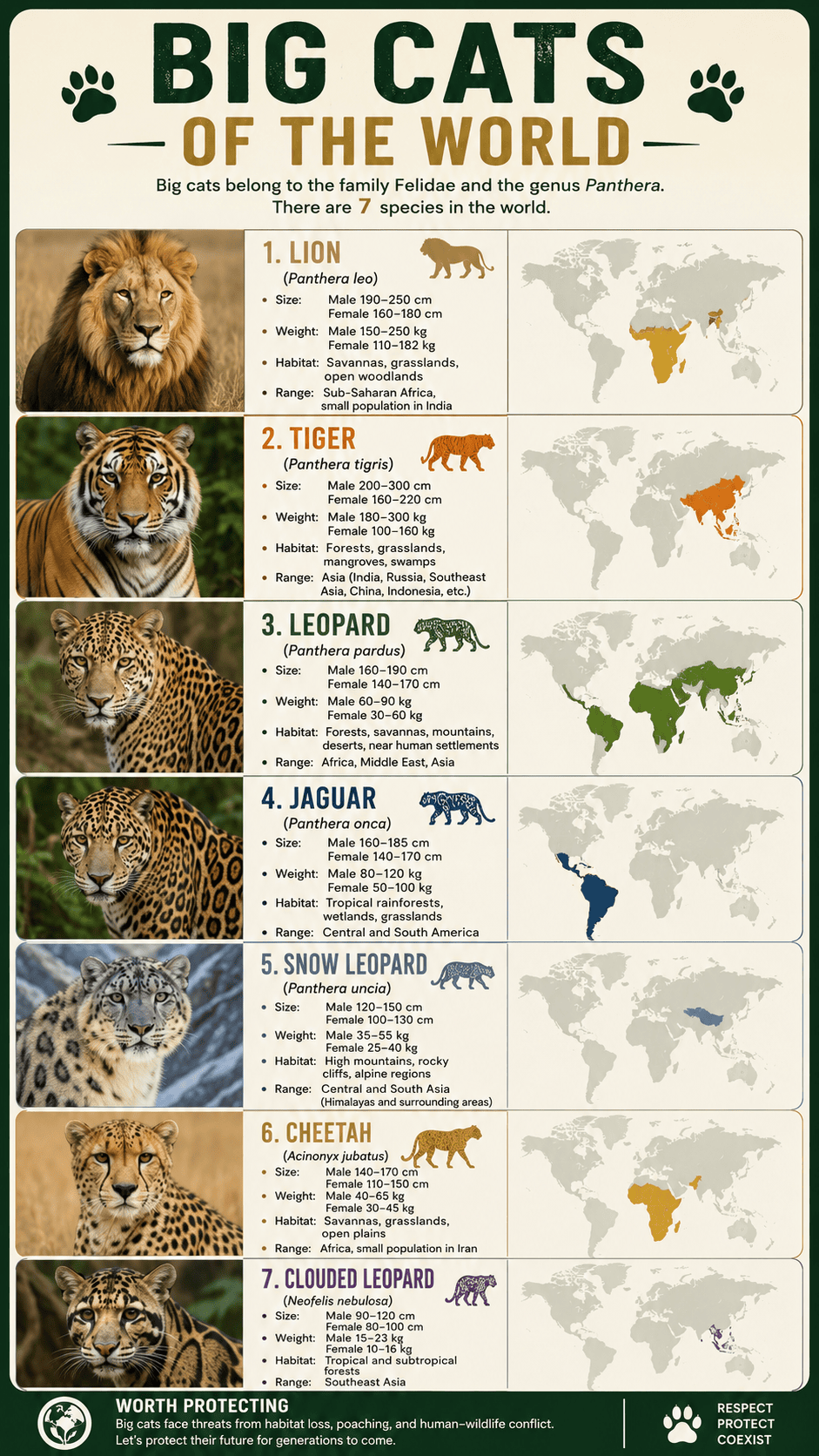
The world’s big cats are among the most fascinating and powerful creatures on Earth. Revered in myths, celebrated in cultures, and admired for their strength and beauty, these magnificent predators have captivated human imagination for centuries. From the roaring lions of Africa to the elusive snow leopards of Asia, big cats play a vital role in maintaining ecological balance across diverse habitats.
This article explores the major big cat species, their unique characteristics, habitats, conservation status, and the challenges they face in the modern world.
In this blog-
Table of Contents
What Are Big Cats?
The term “big cats” generally refers to members of the genus Panthera, which includes lions, tigers, leopards, jaguars, and snow leopards. These animals are distinguished by their size, strength, and, in most cases, their ability to roar. However, in popular usage, the term is often expanded to include other large felines such as cheetahs, cougars, and clouded leopards.
As apex predators, big cats occupy the top of the food chain. Their presence helps regulate prey populations, ensuring healthy ecosystems and biodiversity.
The Tiger: The Largest Big Cat
Tiger is the largest of all wild cats and one of the most iconic predators in the world. Found primarily in Asia, tigers inhabit a variety of environments, including tropical forests, mangrove swamps, grasslands, and temperate woodlands.
A fully grown male tiger can weigh over 300 kilograms and stretch more than three meters in length, including the tail. Its distinctive orange coat with black stripes provides excellent camouflage in dense vegetation.
Tigers are solitary hunters known for their patience and stealth. They rely on powerful muscles and sharp senses to ambush prey such as deer, wild boar, and buffalo. Despite their strength, tiger populations have declined significantly due to habitat loss, poaching, and human-wildlife conflict.
The Lion: King of the Savannah
Lion is often called the “King of the Jungle,” although lions primarily inhabit grasslands and savannahs rather than jungles. Native to Africa, with a small population surviving in India, lions are unique among big cats because they live in social groups known as prides.
A pride typically consists of related females, their cubs, and a coalition of males. This social structure allows lions to cooperate in hunting and defending territory.
Male lions are easily recognized by their impressive manes, which vary in color and size. Their powerful roar can be heard up to eight kilometers away, serving as a warning to rivals and a means of communication with pride members.
Although lions remain one of the most recognizable animals on the planet, their numbers have decreased due to habitat fragmentation and conflicts with livestock farmers.
The Leopard: Master of Adaptation
Leopard is one of the most adaptable big cats in the world. Leopards can survive in forests, mountains, deserts, and even areas close to human settlements.
Their spotted coats provide excellent camouflage, enabling them to stalk prey undetected. Leopards are skilled climbers and often drag their kills into trees to protect them from scavengers such as hyenas.
Unlike lions, leopards are solitary and highly secretive. Their adaptability has allowed them to maintain a wider distribution than many other big cats, though several regional populations remain threatened by habitat loss and illegal hunting.
The Jaguar: Powerhouse of the Americas
Jaguar is the largest cat in the Americas and a symbol of strength in many indigenous cultures. Jaguars are found from Mexico through Central America and into South America, particularly in the Amazon rainforest.
Unlike most big cats, jaguars are excellent swimmers and frequently hunt near rivers and wetlands. They prey on fish, turtles, caimans, and mammals.
Jaguars possess one of the strongest bite forces among all cats. Their powerful jaws enable them to pierce the shells of turtles and the skulls of prey. The distinctive rosette patterns on their coats resemble those of leopards, but jaguars are generally stockier and more muscular.
Deforestation and habitat fragmentation continue to threaten jaguar populations across their range.
The Snow Leopard: Ghost of the Mountains
Snow Leopard inhabits the rugged mountain ranges of Central and South Asia. Known as the “Ghost of the Mountains,” this elusive cat is rarely seen in the wild.
Snow leopards are perfectly adapted to harsh alpine environments. Their thick fur, large paws, and long tails help them survive freezing temperatures and navigate rocky terrain. They can leap distances of up to 15 meters, making them exceptional mountain hunters.
Unlike other members of the Panthera genus, snow leopards cannot produce a full roar. Instead, they communicate through growls, hisses, and chuffing sounds.
Climate change, habitat degradation, and declining prey populations pose significant challenges to snow leopard conservation.
The Cheetah: The Fastest Land Animal
Cheetah is not technically a member of the Panthera genus, but it is often included among the world’s big cats due to its size and prominence.
The cheetah is renowned for its incredible speed, capable of reaching up to 100 kilometers per hour in short bursts. Its slender body, lightweight frame, and long legs are specially adapted for rapid acceleration.
Unlike most large cats, cheetahs rely on speed rather than strength to catch prey. They primarily hunt antelope and other small mammals in open grasslands.
Today, cheetahs face threats from habitat loss, reduced genetic diversity, and competition with larger predators.
Why Big Cats Matter
Big cats are essential for maintaining healthy ecosystems. As apex predators, they control herbivore populations, preventing overgrazing and promoting vegetation growth. This ecological balance benefits countless other species and contributes to overall biodiversity.
In addition to their ecological importance, big cats generate significant economic value through wildlife tourism. Many countries rely on tourists eager to witness these magnificent animals in their natural habitats.
Furthermore, big cats hold deep cultural and spiritual significance for communities worldwide, appearing in folklore, art, literature, and religious traditions.
Conservation Challenges
Despite their importance, most big cat species face serious threats. Habitat destruction caused by agriculture, urbanization, mining, and infrastructure development continues to shrink their natural ranges. Illegal wildlife trade remains a major concern, particularly for species targeted for skins, bones, and other body parts.
Human-wildlife conflict is another growing issue. As human populations expand into wildlife habitats, encounters between people and big cats become more frequent. Livestock predation often leads to retaliatory killings, further endangering already vulnerable populations.
Conservation organizations, governments, and local communities are working together to establish protected areas, improve anti-poaching measures, and promote coexistence strategies. These efforts are critical for ensuring the survival of big cats in the future.
Conclusion
The big cats of the world represent some of nature’s most extraordinary achievements. Whether it is the tiger’s immense power, the lion’s social structure, the leopard’s adaptability, the jaguar’s strength, the snow leopard’s mountain mastery, or the cheetah’s unmatched speed, each species plays a unique role in the ecosystems it inhabits.
Protecting these magnificent predators is not only about saving individual species—it is about preserving the health of entire ecosystems and maintaining the natural heritage of our planet. Through conservation, education, and responsible environmental stewardship, future generations can continue to marvel at the beauty and power of the world’s big cats.